High-power rocket GNC
 Team engineering
Design & simulation
Controlling the coast to apogee
Guidance, navigation, and control work for the WPI High-Power Rocketry Club's two-stage rocket, focused on active-airbrake logic and attitude estimation within vehicle-level constraints.
System architecture
- 01Flight model
- 02State estimation
- 03Airbrake logic
- 04Apogee evaluation
Active-airbrake development
I developed and evaluated active-airbrake control logic using OpenRocket and Simulink. The work connects vehicle simulation with control decisions intended to regulate the rocket's trajectory toward the target apogee.
Attitude estimation
I worked with quaternion-based multiplicative extended Kalman filtering (M-EKF) for attitude estimation and sensor fusion, applying embedded C++ and controls concepts within vehicle-level performance constraints.
Design objectives
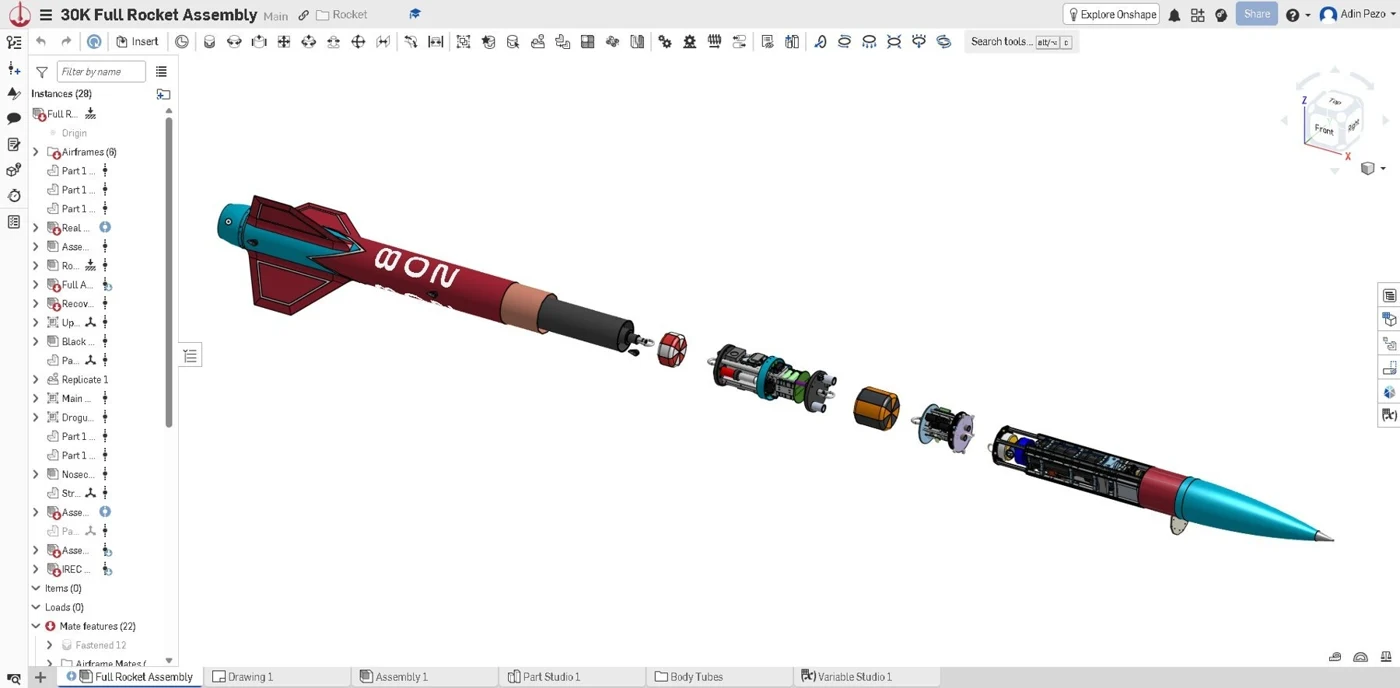
The project targets a 30,000 ft apogee with less than 1% apogee error. These are design objectives, not achieved flight results. The assembly image shows the team's rocket packaging; my documented contribution is to GNC rather than the entire vehicle design.
Design & hardware