6 DOF Rocket Flight Simulator
 Simulation development
Unpowered dynamics prototype
Connecting reference frames and rigid-body motion
A C++ trajectory and attitude model with geographic initialization, rotating-Earth coordinate transformations, aerodynamic forces, quaternion orientation, and CSV-based visualization.
System architecture
- 01Geographic initial state
- 02Frame transformations
- 03Gravity + aerodynamics
- 04State integration
- 05CSV + plots
Trajectory & attitude evolution
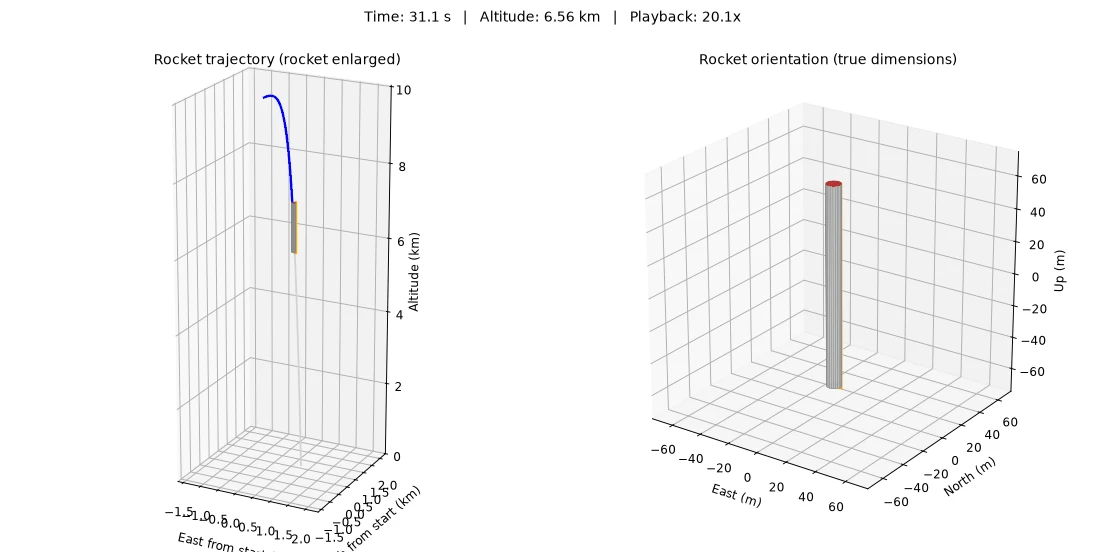
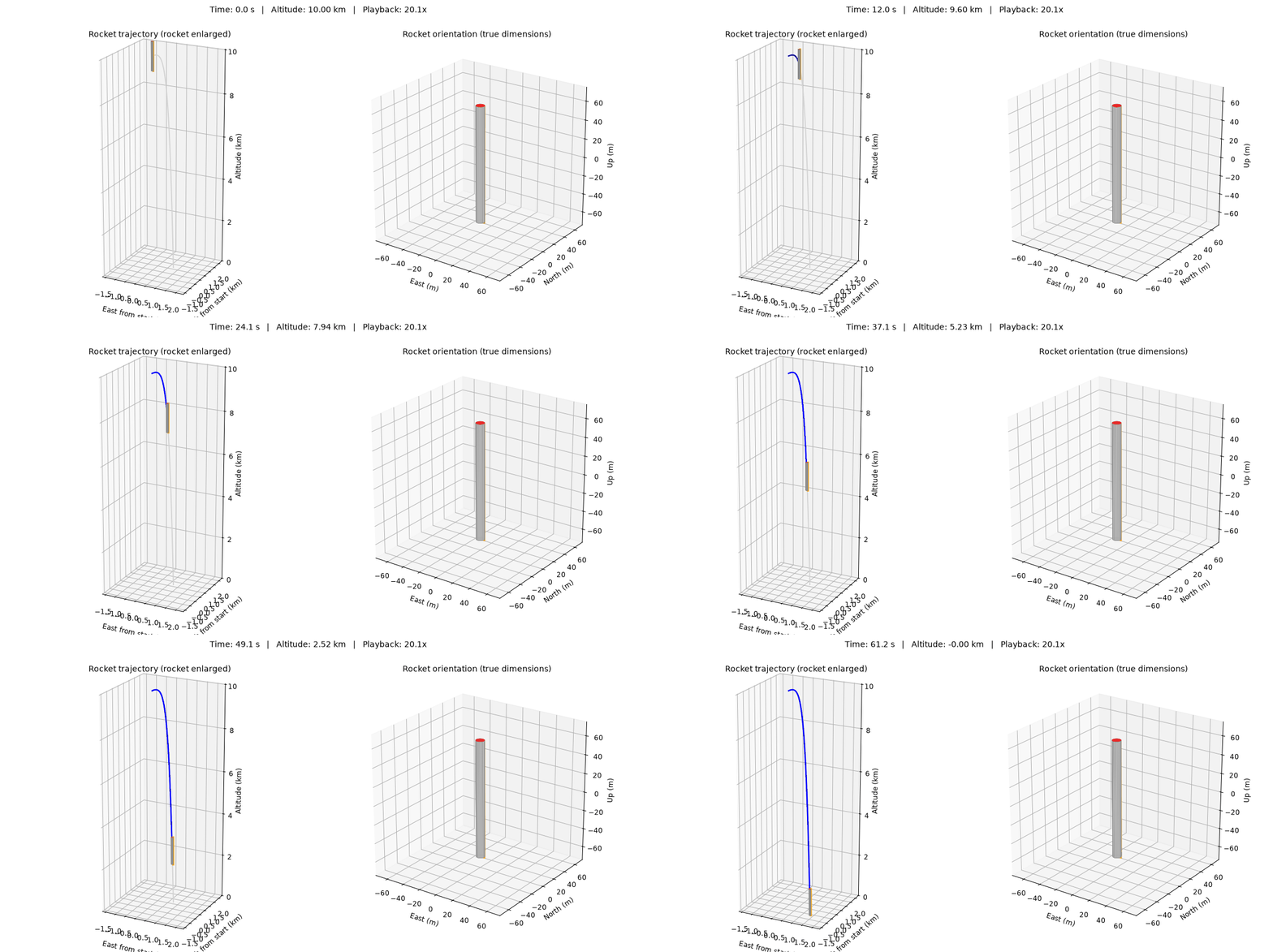
The repository animation shows the rocket moving along its simulated trajectory alongside its changing orientation. The trajectory view enlarges the rocket for visibility.
Reference frames
Initial latitude, longitude, altitude, and local velocity are converted into Earth-centered coordinates. The implementation transforms between local ENU, Earth-fixed ECEF, and inertial ECI frames, including Earth-rotation velocity in initialization and atmospheric relative velocity.
Coupled translation & rotation
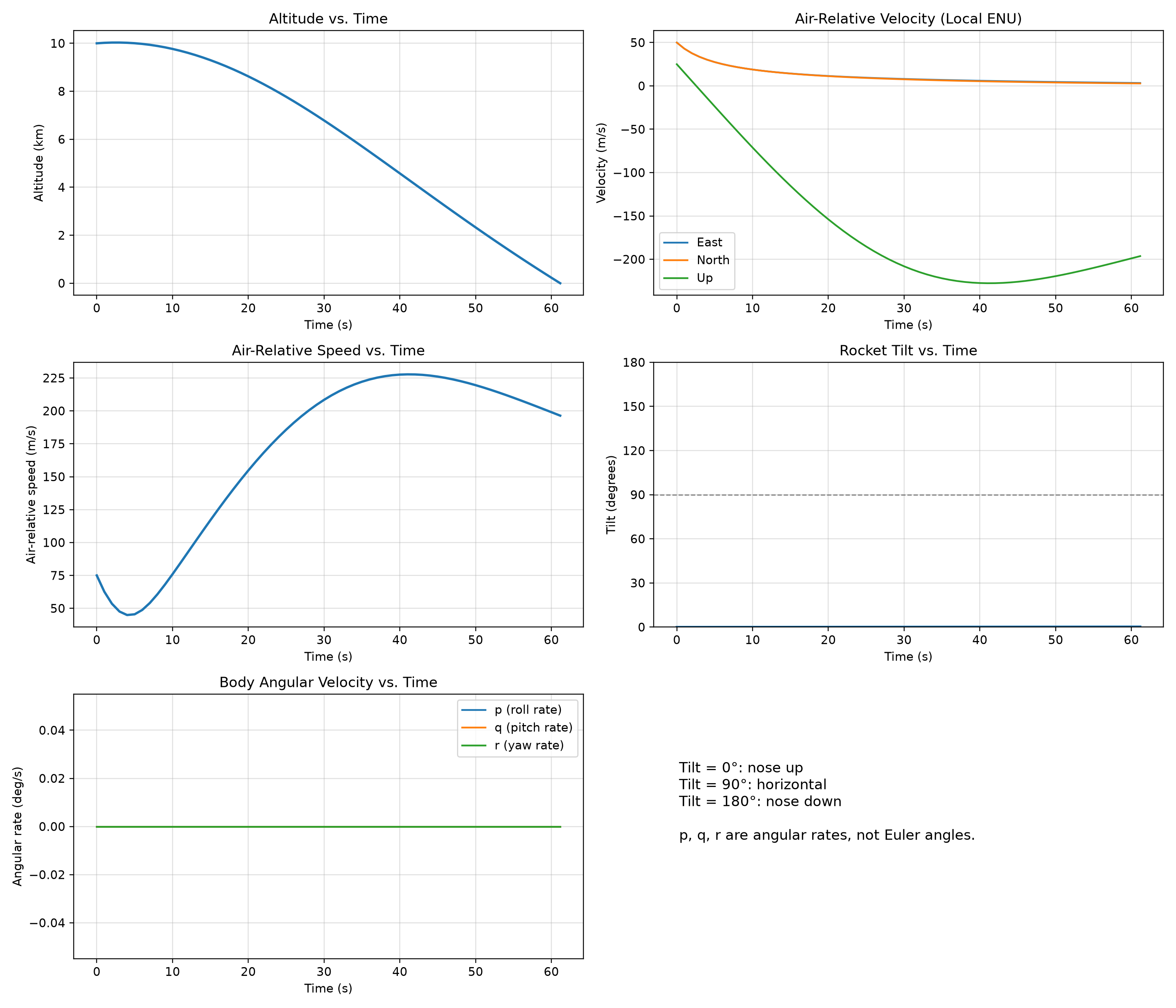
The model advances translational and angular states with a 0.001 s timestep. Body-to-world quaternion rotations connect aerodynamic forces to the trajectory; Euler rigid-body equations and quaternion normalization update rotational motion. The supplied plots are simulation output, not flight-test data.
Current modeling boundaries
The current implementation uses constant mass, an exponential atmosphere, provisional aerodynamic coefficients, and fixed coincident centers of mass and pressure. Thrust, powered landing guidance, and dynamic center-of-pressure modeling are not implemented in the inspected main program. The repository name describes a development direction, not a demonstrated autonomous landing capability.
Design & hardware